

Presence of Chemical Compounds in VLSFO In Malta
Presence of Chemical Compounds in VLSFO in Malta
FINDINGS & INSIGHTS
In the last few weeks CTI-Maritec has tested multiple fuel oil bunker samples from vessels that have taken fuel/bunkered in MALTA and reported operational issues and/or tested to have the presence of high levels of chemical compounds.
Extended Gas Chromatography Mass Spectrometry (GC-MS) testing by ASTM D7845 was conducted for two Very Low Sulphur Fuel Oil (VLSFO) samples, which showed the presence of high concentrations of acetophenone, phenolic compounds (4-cumylphenol, phenol and others), styrene glycol and phenethyl alcohols. Furthermore, testing by Solid Phase Extraction (SPE) GC-MS technique indicated low levels of bisphenol isomers, fatty acids, long chain fatty acids and dehydroabietic acid. All mentioned compounds are non-hydrocarbons. Our GC-MS analysis also indicated the presence of reactive hydrocarbons like DCPD, Dihydro-DCPD, Styrene and Indene.
The common problems encountered, as reported by the vessels, were sludging, filter clogging and in some instances, fuel pump issues associated with phenolic compounds and phenethyl alcohols.
Due to the high levels of these chemical compounds, the fuels do not meet the general requirement and is considered as off-spec fuel as per clause 5 of ISO8217 and MARPOL Annex VI regulation 18 which states:
“The fuels shall be homogeneous blends of hydrocarbons derived from petroleum refining. This shall not preclude the incorporation of small amounts of additives intended to improve some aspects of performance.”
The fuels shall be free from inorganic acids and from used lubricating oils. The fuel should not include any added substance or chemical waste which,
a) jeopardizes the safety of ships or adversely affects the performance of the machinery; or
b) is harmful to personnel; or
c) contributes overall to additional air pollution.”
CTI-Maritec Recommendations:
CTI-Maritec recommends to:
- Closely observe the vessel fuel system/s for signs of filter clogging and purifier sludging and additionally, increase vigilance on the centrifuges to monitor overloading.
- Increase frequency of their de-sludging cycle depending on the accumulated sludge.
- Possibly reduce the Mean Time between bowl cleaning of the purifier and fuel system filters.
- Avoid blending with other fuels, in particular marine diesel and gas oil and also other fuel oil as such mixing may well increase the sediment problem.
Furthermore, at these levels of concentration of chemical compounds present in fuel oil, there is an increased risk of excessive wear to the vessel’s fuel pump plunger and barrel assembly. Therefore, it is advised to monitor the fuel pump index closely to check for deteriorating performance. As a back-up, ensure there are sufficient spare seals and plunger barrel assembly to replace damaged units if necessary.
In addition, as a precaution, it is advised to closely monitor the performance of the engines while using this fuel to detect any deterioration of the fuel injection equipment performance and the sealing effect of the piston rings.
This document, however, does not reflect on the overall quality of fuel being supplied in Malta. If you intend to bunker in this region, please request for a Certificate of Quality prior to loading.
CTI-Maritec can assist you with further information on the quality of bunkers tested in different regions. For further information or assistance please do not hesitate to Contact us.


IHM Renewal: Readiness Requirements Through Robust IHM Maintenance
IHM Renewal: Readiness Requirements Through Robust IHM Maintenance
Introduction:
To ensure compliance with EU Ship Recycling Regulation’s (EU SRR) deadline, which was set for 31 December 2020, the Maritime world saw significant movement during 2019 and 2020 towards developing their vessel’s Inventory of Hazardous Material (IHM) Part I.
Furthermore, the regulation stipulates that upon a five yearly basis from the date of issuance of the IHM Certificate or Statement of Compliance (SoC), an IHM Renewal survey must be conducted by a Recognized Organization or Administration to safeguard adherence to the regulation. It is estimated that the same volume of vessels with IHM Part I developed during 2019/2020 will require renewal surveys in 2024/2025.
Additionally, lately, several certification bodies have also reported seeing more and more IHM Renewal surveys due together with other statutory renewal certification as a part of a harmonization requirement, along with increased number of support cases with questions about IHM Renewal surveys and IHM Maintenance requirements.
KEY INSIGHTS ON IHM MAINTENANCE PROCEDURES & REQUIREMENTS + PSC INSPECTIONS:
One can assuredly state that to complete a successful IHM Renewal, comprehensive and thorough IHM Maintenance is epitome. Therefore, it is imperative to understand what needs to be done to properly maintain the Inventory and to ensure smooth IHM Renewal Surveys as well as ongoing Port State Control (PSC) inspections.
It is also noteworthy to state that in accordance with the Hong Kong Convention (HKC) and EU SRR regulation, the PSC follow very clear-cut and ‘black and white’ inspection checklists to verify IHM vigilance and implementation onboard vessels. Consequently, as per PSC inspections, vessels found not holding an IHM Certificate/SoC or found with an expired IHM Certificate/SoC and/or in non-compliance with the control measures of HazMat in the related Appendices/Annexes are subject to detainable deficiencies. Additionally, no implementation of an IHM Maintenance programme will be reported to the administration for redressal at the next call/survey. Accordingly, a detailed inspection may be carried out in accordance with relevant IMO/EU guidelines.
The following are key requirements for necessary IHM Maintenance implementation:
Establishing a IHM Maintenance Procedure/Manual & Appointing an IHM Designated Person(s): Shipowners must establish an IHM Maintenance procedure/manual, which is integrated into the shipowner’s safety management system and appoint a person responsible for IHM Maintenance, typically named an IHM Designated Person(s) (IHM DP).
Defining a suitable review period for all vessel purchases: Based on the IHM Maintenance procedure, the IHM DP shall review all purchases made for each vessel within an acceptable period (e.g. bi-monthly or quarterly) as should be defined by the ship owner in the IHM maintenance procedure.
Consistent Collection of MD & SDoC forms for ALL Purchased Products: For purchased products, which fall into the scope of IHM Part I, Material Declaration (MD) and Supplier Declaration of Conformity (SDoC) forms must be consistently collected from the suppliers for ALL purchased products. Even if there are no hazardous materials in a product, MD/ SDoC forms must still be collected as they are the shipowner’s evidence that the product is free of hazardous materials.
Maintaining a Change Log & continual update to IHM Part I of any Declared Hazardous Material with issuance of new revisions, including revision dates and revision numbers: If a hazardous material is declared above the specified threshold values in a product, the IHM DP shall update the Inventory and issue a new revision with date and revision number. The IHM DP should record the conducted activities in a change log.
Maintaining a consistently updated IHM Part I, supplemented by MDs & SDoCs: As the Recognized Organization conducting the IHM Renewal survey will examine the previous version of the IHM Part I and compare it with the updated IHM Part I, supplemented by the new MD and SDoC, all versions must be maintained on board. If an item of equipment that contains a hazardous material is removed from the vessel, it too must be removed from the IHM Part I as well. It should be noted that when the term “on board” is used, this means that having digital solutions in place is also acceptable.
Partnering with a third party IHM Maintenance service provider: To optimally manage IHM Maintenance, which is centralized, fully digitalized and diligently kept up to date, ship owners/managers can employ the services of a trusted third-party service provider, who will handle the end-to-end administrative requirements of IHM Maintenance at a vessel or fleet level.
KEY INSIGHTS ON IHM RENEWAL SURVEYS:
The following are key requirements for IHM Renewal surveys (applicable every 5 years from the date of the initial IHM survey):
- Ship’s existing IHM Certificate/SoC.
- The updated IHM (Part I), reflecting any change, replacement or significant repair of structure, equipment, systems, fittings, arrangements and materials since the last survey.
- Implementation of IHM Maintenance system onboard.
- Ship’s IHM Part I maintenance record, MDs and SDoCs reflecting the ship’s hazardous materials management since last IHM survey.
During the IHM Renewal survey, typically the Recognized Organization or Administration will verify that:
- A vessel-specific, maintained and updated IHM Part I is provided on board together with a valid compliance declaration.
- The procedure for maintaining the IHM Part I is on board and integrated into the safety management system.
- The IHM Part I is consistent with the arrangement, structure and equipment of the vessel.
To conclude, without deterrence or delay, ship owners/managers must establish and/or sustain strong IHM Maintenance procedures in proper readiness for IHM Renewal and to avoid any findings of non-compliance.
CTI-Maritec IHM Maintenance Services & Solutions:
Unmatched Experience: Being a leading IHM Part I service provider for 13+ years, we provide a holistic solution to deliver gold-standard IHM & IHM Maintenance services for over 5000 vessels, globally.
Speedy Support from Dedicated Personnel: All our IHM Maintenance clients receive personalized support from dedicated executives that comprehensively maintain all aspects in robust adherence with regulatory requirements.
Digitalised Systems & Platforms: Our IHM Maintenance services & solutions are managed digitally to ensure the utmost ease of access and accuracy of records.
For more information on IHM Maintenance and IHM survey services & solutions, please visit https://www.maritec.com.sg/services/IHM_Recycling or please write to us at admin@maritec.com.sg .
Click Here to download the PDF version
Newsletter & Whitepapers
U.S. EPA Investigates Biodiesel Supply Chains as Concerns Grow on Feedstock Sources
U.S. EPA Investigates Biodiesel Supply Chains as Concerns Grow on Feedstock Sources
Introduction:
The U.S. Environmental Protection Agency (EPA) has launched investigations into the supply chains of at least two renewable fuel producers amid industry concerns that some may be using fraudulent feedstocks for biodiesel to secure lucrative government subsidies. The action by the EPA comes as farm groups and a growing number of lawmakers press the government to address worries that Used Cooking Oil (UCO), a valuable ingredient for making renewable fuels, could be fraudulent.
The Investigation:
The investigations primarily focus on auditing UCO supply chains of domestic renewable fuel / biofuel producers to verify whether the feedstock qualifies under the Renewable Fuel Standard (RFS).
The audits seek to track the source of the UCO following the suspicions that the UCO supply entering from Asia may not be authentic and is instead being mixed with fresh vegetable oils, such as palm oil, which is potentially distorting commodity values and undermining US biofuel laws.
Palm Oil, one of the world’s most widely used vegetable oils, is a significant pain point to environmentalists and many countries because the industry is tied to labor abuses and is a key driver of deforestation and environmental damage.
The production of biodiesel from sustainable ingredients can earn refiners a string of state and federal environmental and climate subsidies, including tradable credits under the RFS programme. But the mounting fears that the supplies/renewable fuel sources are tainted with much less sustainable virgin palm oil would sit in violation of the RFS programme.
In similar news reported, governments in France, Germany and the Netherlands also recently called on the European Union (EU) to adopt stricter checks on overseas suppliers of biofuel as the EU investigates allegations of fraud in imports from Asia. This too arose from concerns on whether the fuel can be truly deemed certifiably sustainable, given the adverse environmental damage caused through their actual harvesting practices.
Conclusion:
While the EPA investigations are ongoing and yet to be concluded, this latest probe by the U.S. EPA is reflective of the prevalent global shift towards driving robust sustainable practices across borders and industries. To achieve justifiable sustainability, upholding sustainability standards in every aspect of the supply chain is central to the core principles of programmes such as the RFS.
Sources: EPA Probes Biodiesel Supply Chains as Fraud Concerns Mount – BNN Bloomberg | Exclusive: US EPA says it is auditing biofuel producers’ used cooking oil supply | ReutersEPA probes US biofuel producers’ UCO supplies | Latest Market News (argusmedia.com) | France, Germany urge tougher EU checks on biofuel imports in fraud probe | Reuters
CTI-Maritec ISCC EU Certification Audit & Consultancy Solutions:
ISCC is a globally applicable sustainability certification system and covers all sustainable feedstocks, including agricultural and forestry biomass, biogenic wastes and residues, circular materials and renewables. With currently over 10,000 valid certificates in more than 120 countries, ISCC is among the world’s largest certification systems. It has been developed through an open multi-stakeholder process and is governed by an association with more than 230 members, including research institutes and NGOs. As a no-deforestation standard with a strong commitment to protecting forests, high-carbon stock lands and biodiversity, ISCC strives for a world where biomass and other raw materials are produced in an environmentally, socially and economically sustainable manner.
CTI-Maritec provides a comprehensive solution in the areas of ISCC EU implementation consultancy services as well as certification audit services through the ISCC Certifying Body, CTI Certification (CN198).
Through our ISCC solutions we not only support our clients in achieving their sustainability goals but also in their transformative journey towards thinking, operating and innovating as an organisation of the future.
Newsletter & Whitepapers
High Catfines Found in the ARA Region
High Catfines Found in the ARA Region
FINDINGS & INSIGHTS
From the period of 08 May 2024 to 05 July 2024, Maritec Pte Ltd (hereafter referred to as CTI-Maritec) tested twenty-two samples representing both HSFO and VLSFO deliveries from various suppliers in the Amsterdam-Rotterdam-Antwerp (ARA) region, which showed Aluminium and Silicon (Al+Si) concentrations ranging from 40 mg/Kg up to 177 mg/kg.
Out of the twenty-two samples, CTI-Maritec found Aluminium and Silicon (Al+Si) concentrations in two samples to be above 100 mg/Kg and in one sample at 68 mg/Kg level.
While the rest of the samples fell within the specifications of ISO8217:2005 (80 ppm) and even within the ISO8217:2010/2017 specification (including permitted limits of 72 PPM as per ISO4259 for a single test result), the Catfines content were still considered at high levels. Many of these samples were also found to have high density, high TSP and high CCAI.
Aluminium and Silicon are main classes of abrasive solids found in fuels. High levels of abrasive particles at the engine inlet may lead to abnormal wear and tear of the fuel system components, piston rings and cylinder liners. To control the maximum amount of catalyst fines delivered to the engine, many engine builders specify a maximum limit of 15 mg/kg of Aluminium plus Silicon at engine inlet.
An efficiently operating fuel purification system is the main way of removing these particles. Measuring the fuel’s Aluminium and Silicon concentrations before and after centrifuge provides an indication of the efficiency of the system in removing catalyst fines.
Due to relatively high TSP, fuels might generate increased sludge formation, especially at the Purifiers and filters. Due to high CCAI, fuels might have ignition and combustion related issues.
Our Recommendations:
CTI-Maritec recommends collecting samples from within the fuel system at points such as the fuel oil tank transfer pump, before and after centrifuge, service tank and after filter samples to check the fuel cleaning efficiency.
This document, however, does not reflect on the overall quality of fuel being supplied in ARA region, if you intend to bunker at this region please request for a Certificate of Quality prior to loading.
CTI-Maritec can assist you with further information on quality of bunkers tested in different regions. If you require any other information or assistance do not hesitate to Contact us.
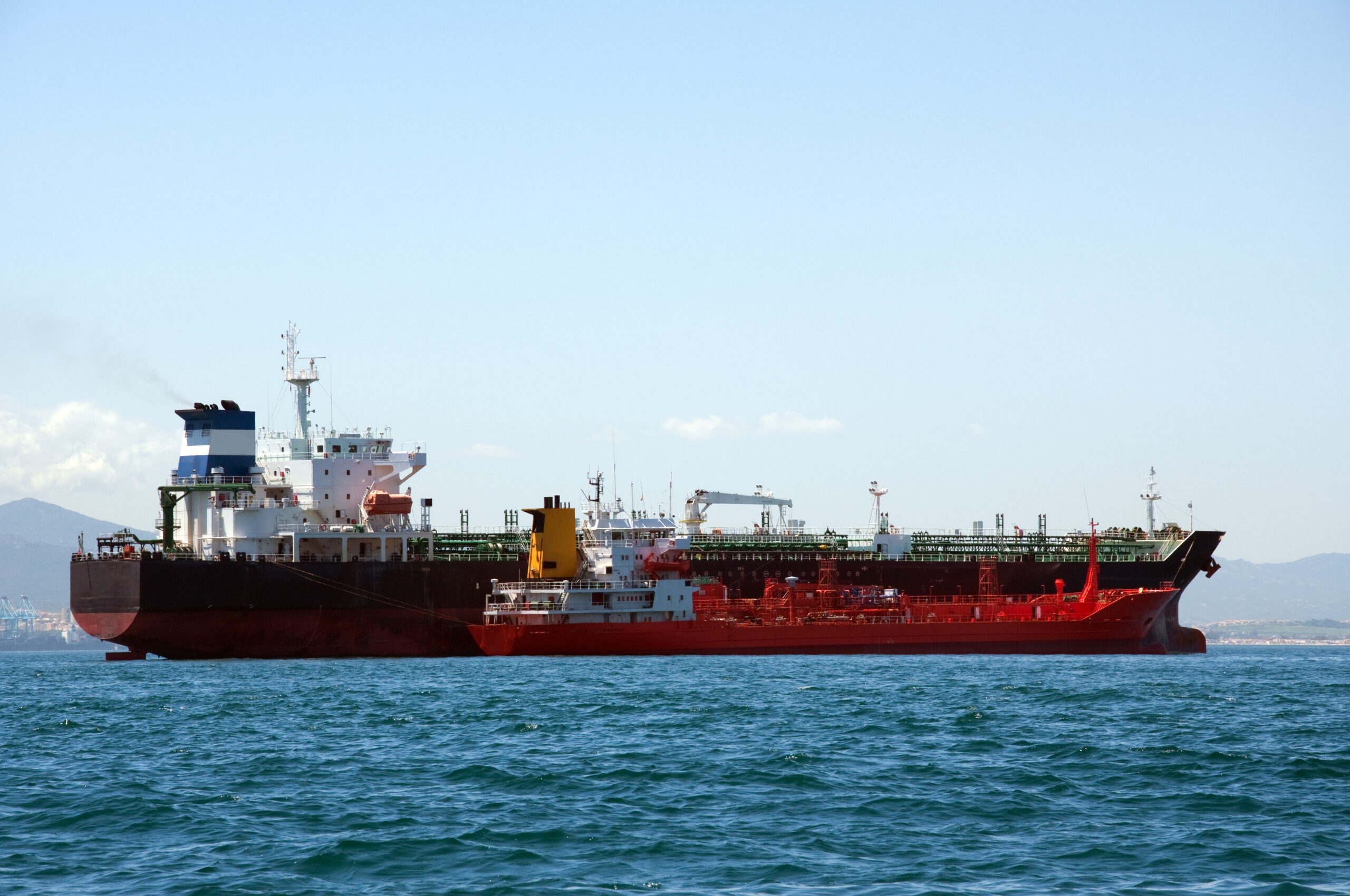
USCG’s PSC 2023 Annual Report Shares Key Insights on Deficiencies & Trends of Ballast Water Management
USCG’s PSC 2023 Annual Report Shares Key Insights on Deficiencies & Trends of Ballast Water Management
Introduction
The 2023 Annual Report as issued by the Port State Control (PSC) division of United States Coast Guard (USCG) presents vital insights on last year’s deficiencies issued for non-compliance with critical regulatory requirements / parameters for effective Ballast Water Management (BWM). Additionally, the report pointedly showcases the number of vessels (categorised by vessel type) that were issued BW deficiencies, as a means to indicate the most frequent non-compliers.
In 2023 alone, a total of 10,959 individual vessels, from 80 different flag administrations, called 81,854 US Ports, & 8,278 exams were conducted by the PSC. From these statistics one can get a sense of the pressing need for and importance of implementing and closely monitoring responsible practices to protect the ecosystems in which these vessels operate.
Trend analysis of BWM deficiencies issued in 2023 by USCG’s PSC
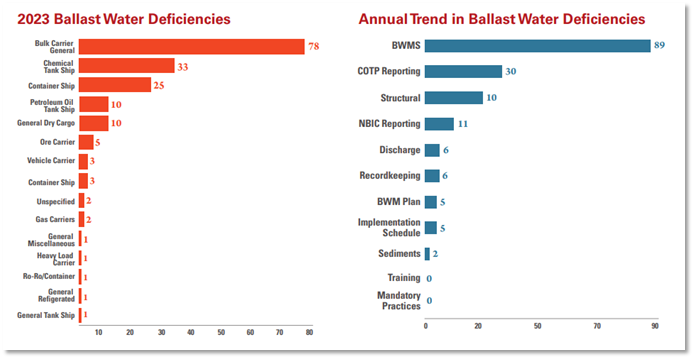
Graphs 1 & 2 as issued in USCG’s PSC 2023 Annual Report (Source: https://www.dco.uscg.mil/Portals/9/DCO%20Documents/5p/CG-5PC/CG-CVC/CVC2/psc/AnnualReports/annualrpt2023a.pdf)
Understand why deficiencies are issued under certain critical parameters
- BWMS: Deficiencies issued include both inoperable Coast Guard Type Approved systems and accepted Alternative Management Systems.
- COTP Reporting: Deficiencies are issued when a vessel fails to report an inoperable system to the USCG.
- Discharge: Deficiencies are issued when a vessel discharges non-compliant ballast water.
- Implementation Schedule: Deficiencies involve vessels that are past their compliance date and using an unapproved BWM method.
- Mandatory Practices: Deficiencies include failures to remove hull fouling organisms and marine growth as well as improper uptake of ballast water.
- Structural: Deficiencies record failures in ballast water tanks and associated piping.
Other key highlights:
- 29% less deficiencies were issued in 2023 as compared to the previous year.
- Concerns still lie in the significant increase seen in structural deficiencies, which indicates that vessel operators will need to evaluate the ship’s maintenance and surveys to identify the structural inadequacies.
- The decline in BWMS deficiencies in 2023 shows the value of the Enhanced Examination Program (EEP) that was conducted in 2022.
- It is believed, the EEP contributed to identification of more discharges of non-compliant ballast water into the waters of the United States as well as showing an increase of non-reported inoperable ballast water systems.
- Plans to conduct more EEP exams are upcoming.
Summary of important elements of EPA’s Vessel General Permit (VGP) 2013
(The VGP is the current mandatory regulatory requirement for Discharge Water Compliance for vessels operating in US waters)
- The final 2013 VGP is a permit issued by the U.S. EPA that regulates the discharges incidental to the normal operation of commercial vessels greater than 79 feet in length.
- The final 2013 VGP covers 27 specific discharge categories that were contained in the 2008 VGP, and also provides coverage for fish hold effluent in the event that a permitting moratorium expires.
- The final 2013 VGP aims to protect the quality of the US waters by imposing effluent limits, best management practices, and monitoring requirements for various types of vessel discharges – primarily through enforcment of stipulated frequencies at which annual testing of BW (depending on the BW system type) must be conducted, official reporting requirements and record keeping, among several other stipulations.
The following will provide you access to:
- The Final VGP 2013 document
- A Fact Sheet (Provides the technical basis for the derivation of VGP requirements.)
CTI-Maritec provides ‘VGP Annual Programme’ services, a unique one-stop solution to meet all your Discharge Water Compliance requirements as per VGP 2013. Benefit from:
- Risk Mitigation: We assist clients monitor and identify Testing Frequencies for every contracted vessel in accordance with the VGP.
- Budget Control: We monitor vessel voyages to select the most economical ports for sampling/testing.
- Global Network: We offer testing worldwide for convenient sampling and reporting.
- Technical Support: We offer Audit & Crew Training and due-diligence support for vessel operational records review.
- Error Proof Processes: Our mindfully designed programme ensures all layers of requirements are systematically met before submission to EPA.
- Annual Reporting Support: We can provide expert support for the Annual Report preparation and submission on the EPA website
- Quick-response Times: Our dedicated personnel provide query management support on a real-time basis.
- Reduced Superintendent (SI) Workload: Our un-matched expertise in managing the administrative end-to-end requirements of the VGP alleviates a SI’s workload, allowing for better focus on decision making.
For more information on our Discharge Water Compliance services & solutions visit our website at Water Compliance Services (maritec.com.sg) or write to us at admin@maritec.com.sg.
Click here to download the PDF version of this Newsletter.
Newsletter & Whitepapers
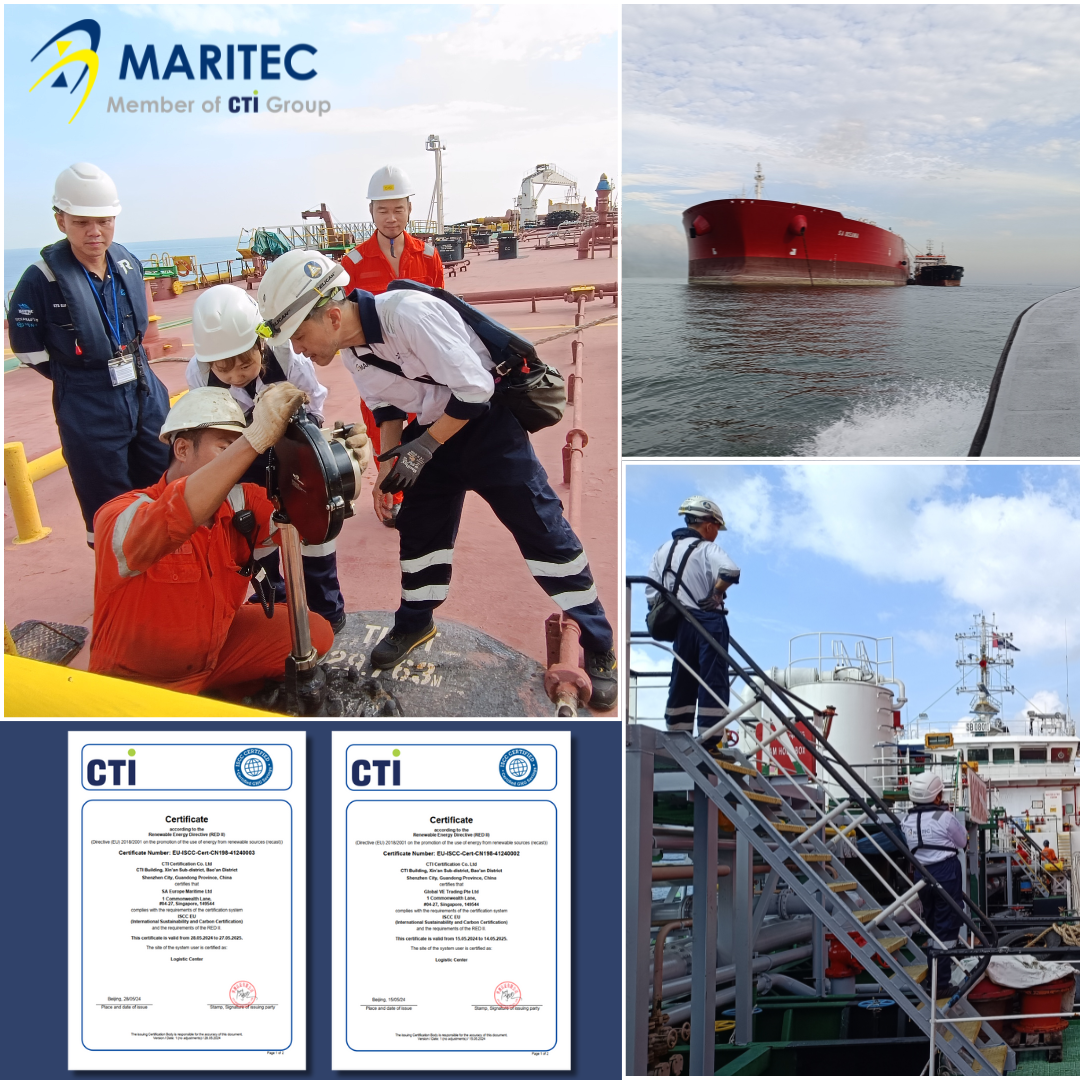
CTI-Maritec Congratulates Clients on ISCC Certification
CTI-Maritec Congratulates Clients on ISCC Certification
It is with great pleasure we extend our congratulations to the Management and Sustainability Department of Global VE Trading and SA Europe Maritime on becoming the first two ISCC EU certified Floating Logistic Centre in the Southeast Asia region. This achievement not only highlights their commitment to sustainable practices but also sets a benchmark for excellence within the maritime industry.
Achieving ISCC EU certification requires significant effort, and it reflects the unwavering commitment to innovation and sustainability. This pioneering accomplishment will undoubtedly inspire others within the industry to strive for similar excellence and adherence to sustainable operations. CTI-Maritec was happy to offer ISCC EU implementation consultancy prior to certification audit by ISCC Certifying Body, CTI Certification (CN198).
The ISCC EU (International Sustainability & Carbon Certification) is a robust certification system that plays a significant role in promoting sustainability across various sectors, including bioenergy, agriculture, and increasingly, non-bio-based energy. It contributes to sustainability in several keyways. It validates that sustainably sourced feedstocks are utilized, confirming emissions data from the fuel production process, and establishing a thorough system for data and records management. This ensures complete traceability and transparency, among other stipulated requirements.
Being ISCC certified allows collaboration with other ISCC certified stakeholders within the supply chain to uphold the sustainability standards and preserving the recognition of the fuel. We look forward to seeing the positive impact that the continued leadership in these 2 companies will have on our industry and the environment.
Congratulations once again on setting a ground-breaking precedent!
For more information of ISCC Consultancy & Certification services please write to admin@maritec.com.sg
Enhanced Fuel Testing Parameters from Singapore MPA & TESTING Recommendations
Enhanced Fuel Testing Parameters from Singapore MPA & TESTING Recommendations
Introduction
On 8 February 2024 the Maritime and Port Authority of Singapore (MPA) issued a Port Marine Circular No 3 of 2024 regarding the implementation of enhanced testing parameters for marine fuel batches intended to be delivered as bunkers in the Port of Singapore in addition to the existing quality assurance measures.
In accordance with the MPA’s Port Marine Circular No 3 of 2024, from 1 June 2024 onwards, bunker suppliers in the Port of Singapore must ensure that:
- Residual & Bio-residual bunker fuel do not contain Chlorinated Organic Compounds (COC) above 50mg/kg and are free from inorganic acids.
- COC must be tested using the EN 14077 accredited test method and shall be reported in the “Certificate of Quality” (COQ) provided to receiving vessels.
- Inorganic acids must use the ASTM D664 accredited test method as prescribed in ISO 8217 and the Strong Acid Number (SAN) (in addition to the Total Acid Number (TAN) shall be reported in the COQ (i.e. SAN = 0) provided to receiving vessels. For distillate / bio-distillate bunker marine fuel batches, SAN must be tested as per ASTM D664 test method and reported in the COQ.
- Residual marine fuels are free from polystyrene, polypropylene & polymethacrylate. These can be tested by filtration, microscopic examination, & Fourier-Transform Infrared spectroscopy analysis.
Testing Recommendations in line with MPA Enhanced Parameters to Protect Your Vessels:
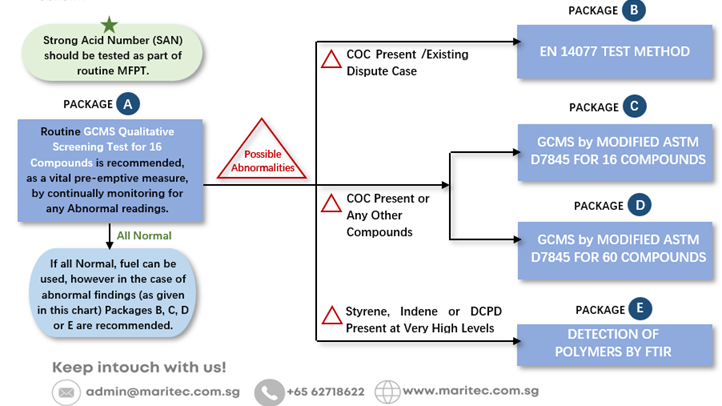
In view of the above, CTI-Maritec recommends fuel testing protocols as depicted in the chart below (as routine pre-emptive measures and/or for deep dive requirements to detect the root cause) to help safeguard vessel health.
Our recommendations are primarily focused at COCs and SAN detection for bunker supply in Singapore, while recommendations for testing Polymers is advised for requirements of reported problem cases or when highly abnormal GCMS findings of chemical compounds like Styrene, DCPD and Indene are detected.
CTI-Maritec’s provides gold-standard Fuel Quality Testing Services & Solutions including cost effective routine and enhanced testing solutions to help safeguard your vessels. Benefit from:
- Accredited Labs, Equipment and Testing Procedures: CTI-Maritec is certified by SAC SINGLASS
- Latest Equipment & Technology: CTI-Maritec uses the latest technology and procedures on the market to ensure best-in-class testing in the bunker fuel testing market.
- Enhanced Analysis: In addition to routine testing, CTI-Maritec offers intuitively designed customizable packages to deep dive into investigating the root cause of any abnormal findings
- Technical Support: CTI-Maritec provides focused technical support through our team of highly qualified experts who deliver personalized guidance to our customers whenever required.
- Long Standing Systems & Infrastructure: CTI-Maritec has been a trusted Fuel Testing partner since 1999 and possesses the expertise, set-up and procedures to provide 24×7 quick, efficient and credible services.
- Dedicated Customer Support: CTI-Maritec’s dedicated Customer Service Executives are always on-hand to provide speedy assistance on a real-time basis.
- Cost Effectiveness: Owing to our experience in the field, packages and solutions are design to be cost effective and customizable to suit every budget.
The range of analytical techniques include:
- GCMS by headspace, ASTM D7845 by Direct Liquid Injection & Solid Phase Extraction (SPE)
- Quantification of Total Chlorinated Organic Compounds (COCs) by EN14077 test method
- Fuel Ignition and Combustion Analyzer (FCA)
- Fuel Stability by P-value via SMS 1600
- Solid Contaminants by FT-IR
- Determination of Cat Fine Size Distribution
- Biofuel Testing Packages for blends ranging from B20 to B100
- FOMP (Fuel Operation Management Package)
For more information, please visit our website at https://www.maritec.com.sg/services/Fuel_Testing&Solution or write to us at admin.maritec.com.sg
Newsletter & Whitepapers
BioFuel Testing and Key Pre-emptive Measures
BioFuel Testing and Key Pre-emptive Measures
Introduction
TO LOOK TO THE FUTURE, LET’S TAKE A SMALL STEP BACK…
Owing to several influencing factors, mainly stemming from concentrated efforts towards achieving crucial sustainability and decarbonization goals, the use of BioFuels is gaining swift momentum as a transitional fuel in the Maritime industry.
The advantages of BioFuels as a promising transitional fuel for vessels, in particular biodiesel blends, are that they can be used as drop-in fuel without modification of existing marine diesel engines and the Fatty Acid Methyl Esters (FAMEs), a primary component, do not emit Sulfur Oxides (SOx) during their combustion.
Over the last few years, regulatory bodies have also determinedly progressed on building viable frameworks and guiding principles on robust compliance requirements, implementation of transparent and functional processes, and setting in place definitive best practices to support the Maritime world in their decarbonisation journey.
Namely, in July 2023 at the 80th session of the Marine Environment Protection Committee (MEPC 80) IMO adopted the 2023 IMO Strategy on Reduction of GHG Emissions from Ships, with enhanced targets to tackle harmful emissions. The 2023 IMO GHG Strategy envisages, in particular, a reduction in carbon intensity of international shipping (to reduce CO2 emissions per transport work), as an average across international shipping, by at least 40% by 2030, compared to 2008. The 2023 IMO GHG Strategy also includes a new level of ambition relating to the uptake of zero or near-zero GHG emission technologies, fuels and/or energy sources which are to represent at least 5% (striving for 10%) of the energy used by international shipping by 2030.
Furthermore, the soon to be released (expected in the 2nd quarter of 2024) latest edition of ISO 8217:2024, is foreseen to have substantial inclusions of updated parameters for BioFuel testing.
All the above-mentioned advancements towards adopting procedures and means to bring about tangible change are reflective of the inevitable paradigm shift (we can, in truth, already observe taking place) in fuel usage and energy sources in the Maritime landscape. Yes, it will require significant commitment towards investment in scale-ups, however, one can almost be assured that major change will come sooner than we realise and this will mean having to effectively manage a vessel’s fuel quality testing requirements in a new light.
IN ADDITION TO ROUTINE PARAMETERS, WHAT KEY PRE-EMPTIVE PARAMETERS SHOULD BE PAID SPECIAL ATTENTION TO WHEN TESTING BIOFUEL?
A comprehensive analysis of a BioFuel sample as per ISO 8217 will test its compositional makeup and characterization, as well as assessing its overall quality. It should also determine the presence and concentration of contaminants like ash, strong acids, organic chlorides and others, which can compromise the performance of the fuel.
Key pre-emptive measures and parameters from a commercial, environmental and operational point of view, which should be paid special attention to when testing BioFuel are summarised below:
- FAME Content: FAME is more costly when compared to conventional bunker fuel. When ordering biodiesel blends, the FAME content is agreed between buyer and seller, from commercial & environmental (emission benefits) point of view, it is important to measure the FAME content in order to ensure that the correct FAME content is received as per the biodiesel blend transaction.
- Net Heat of Combustion or Energy Content: Biodiesel blends have lower energy content when compared to conventional fossil fuels and the calculated net specific energy commonly used for fossil fuels may not apply to biodiesel blends. From an operational point of view in order to plan for the consumption of biodiesel blends for a voyage and to determine the engine’s performance accurately, lower calorific value (or net heat of combustion) shall be measured.
- Oxidation Stability & Long-term Storage Stability: FAME oxidizes readily to form precipitates, which can clog filters, while increased acidity from oxidized fuel can foul injectors.
- Low Temperature Operation: FAME has a higher cloud point when compared to petroleum diesel which can potentially cause wax formation at lower temperature leading to filter clogging.
- Microbial Growth: FAME has great affinity for water to form stable emulsion. FAME and water emulsion (fuel haziness) can generate microbiological growth which leads to excessive formation of sludge that can clog filters and affect engine performance.
- Corrosion: Microbial growth can produce Sulphide Reducing Bacteria (SRB) causing corrosion of steel tanks. Water can promote hydrolytic reactions, breaking down the FAME to form free fatty acids. Such species are corrosive and may attack exposed metal surfaces.
- Deleterious Materials: Impurities such as free fatty acids, monoglycerides & glycerol (derived from low grades FAMEs used to blend biofuels), chlorinated organic compounds and other deleterious materials when present can pose detrimental effect on machineries and engine performance.
In view of the potential operation risks mentioned above (more likely in the case of BioFuels due to their composition make-up), it is advised that vessel owners should pre-emptively conduct additional analysis when routine ISO 8217 analysis indicates elevated values for some critical parameters.
The additional analysis should mainly be aimed at closely monitoring aspects and properties related to oxidative stability & long-term storage stability, low temperature operation, microbial growth, corrosive effects, deleterious materials and others.
|
CTI-Maritec’s provides gold-standard Biofuel Testing Services & Solutions including cost effective routine and enhanced testing solutions to help safeguard your vessels. Benefit from:
|
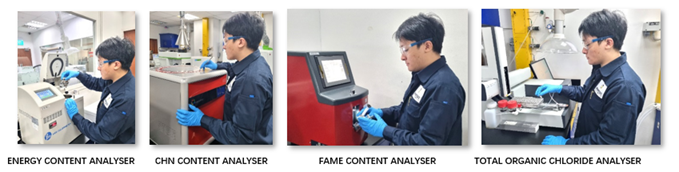
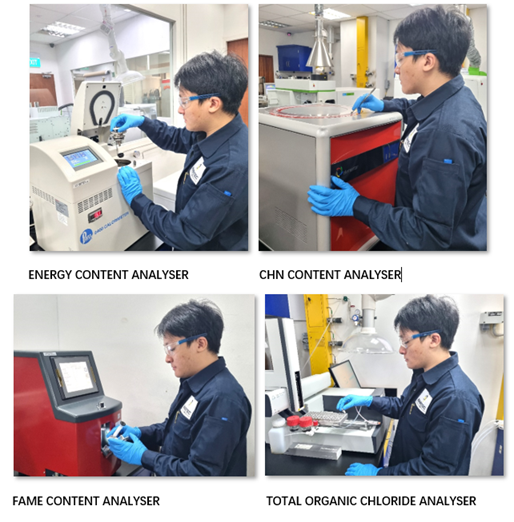
In keeping with our commitment to providing world-class services, we conduct BioFuel Analysis for routine and enhanced testing using the latest cutting-edge technology, as seen below:
Newsletter & Whitepapers
CTI-Maritec Insights & Recommendations on SINGAPORE MPA’s Enhanced Testing Parameters For Marine Fuel Batches
CTI-Maritec Insights and Recommendations on Singapore MPA's enhanced testing parameters for Marine Fuel Batches
Table of Contents
- 1. INTRODUCTION
- 2. CHLORINATED ORGANIC COMPOUNDS (COCS)
- 2.1 Effects of COCs in Marine Fuels & Regulatory Requirements
- 2.2 CTI-Maritec Insights & Recommendations on Testing Approach
- 2.3 CTI-Maritec Case Study A: COCs Contamination
- 3. STRONG ACIDS
- 3.1 Effects of Strong Acids in Marine Fuels & Regulatory Requirements
- 3.2 CTI-Maritec Insights & Recommendations on Testing Approach
- 3.3 CTI-Maritec Case Study B: TAN Levels
- 4. POLYMERS
- 4.1 Effects of Polymers in Marine Fuels & Regulatory Requirements
- 4.2 CTI-Maritec Insights & Recommendations on Testing Approach (recommended in cases of reported problems)
- 4.3 CTI-Maritec Case Histories A – D of identifying Polymers using In-house FT-IR Spectroscopy Method
- 5. CTI-MARITEC EXTENDED ANALYSIS TESTING
- 6. CONCLUSION
- 7. REFERENCES
Introduction
In the year 2022, in what can be described as one of the most significant fuel supply scandals in recent history, approximately 200 vessels were supplied with contaminated bunker fuel in the Port of Singapore. Arising from this bunker contamination incident in Singapore, an Industry Expert Group (IEG) co-chaired by the Maritime and Port Authority of Singapore (MPA) and Singapore Shipping Association (SSA) conducted thorough investigations, which revealed that the affected fuel was a blended product of High Sulphur Fuel Oil (HSFO) that contained high concentration levels of Chlorinated Organic Compounds (COC), mainly constituting 1,2-Dichloroethane, Tetrachloroethylene and other chlorinated organic compounds.
Ships that received this HSFO reported various ruinous damage, such as failure of main engines, auxiliary engines, fuel pumps, plunger barrel and injection equipment.
To help mitigate future incidents, on 8 February 2024 the MPA issued a Port Marine Circular No 3 of 2024 regarding the implementation of enhanced testing parameters for marine fuel batches intended to be delivered as bunkers in the Port of Singapore in addition to the existing quality assurance measures.
In accordance with the MPA’s Port Marine Circular No 3 of 2024, from 1 June 2024, bunker suppliers in the Port of Singapore must ensure that:
- Residual & bio-residual bunker fuel do not contain Chlorinated Organic Compounds (COC) above 50mg/kg and are free from inorganic acids.
- COC must be tested using the EN 14077 accredited test method and shall be reported in the “Certificate of Quality” (COQ) provided to receiving vessels.
- Inorganic acids must use the ASTM D664 accredited test method as prescribed in ISO 8217 and the Strong Acid Number (SAN) (in addition to the Total Acid Number (TAN) shall be reported in the COQ (i.e. SAN = 0) provided to receiving vessels. For distillate / bio-distillate bunker marine fuel batches, SAN must be tested as per ASTM D664 test method and reported in the COQ.
- Residual marine fuels are free from polystyrene, polypropylene & polymethacrylate. These can be tested by filtration, microscopic examination, & Fourier-Transform Infrared spectroscopy analysis.
In view of the above, CTI-Maritec shares the following insights and recommendations related to the testing of COCs, TAN and SAN for all bunker supply in Singapore, and our recommendations for testing Polymers for reported problem cases.
Newsletter & Whitepapers

Understand the Key Changes of Newly Released ISO 8217:2024
Understand the Key Changes of Newly Released ISO 8217:2024
Introduction
The latest version of ISO 8217, ISO 8217:2024, was published on 30 May 2024. In this latest version, the scope of the specification for marine fuel has been expanded to include BioFuel, specifically in relation to Fatty Acid Methyl Esters (FAMEs).
To highlight in particular, the specification indicates that when marine fuel consists of 100% FAME, the FAME should meet EN 14214 or ASTM D6751 test methods, and the product should also meet the applicable grade in ‘Table 1’ of the new ISO 8217:2024. In addition, marine fuel consisting of 100% paraffinic fuel, such as hydrotreated vegetable oil (HVO), the paraffinic diesel should meet EN 15940 test method, and the product should also meet the applicable grade in ‘Table 1’.
Overview of overall key changes of ISO 8217:2024
- The Scope and the general requirements in Clause 5 have been amended.
- Tables 2 and 3 have been added.
- Former Table 2 has been modified and has become Table 4.
- General requirements – clauses 5 to 10 – have been incorporated in Table 1 to Table 4.
- The minimum requirement for KV50 has been added to Table 2, Table 3 and Table 4.
- A fuel shall be considered to be free from organic chlorides (chlorinated hydrocarbons) when the total organic halogen content as chlorine is not exceeding 50 mg/kg when tested in accordance with EN 14077 is added in clause 6.17.
- Clauses 9 (Requirements for marine fuel consisting of 100 % FAME or paraffinic diesel fuel) and (Clause 10) Generally applicable requirements and related test methods have been added.
- Annexes on Cold flow characteristics, Stability of residual fuels and Characterization of residual marine fuels have been added.
- Viscosity-gravity Constant (VGC), calculated using ASTM D2501, is introduced in “Characterization of residual marine fuels” Annex. VGC provides an indication of a fuel tendency to be more paraffinic or aromatic. Values of VGC near 0,80 indicate the fuel of a paraffinic character, while values close to 1,00 indicate a preponderance of aromatic structures.
Changes of Table 1: Distillate and bio-distillate marine fuels
- The requirement to report the fatty acid methyl ester(s) content (FAME) of DF grades has been changed, allowing up to 100%.
- The distinction between winter and summer quality for cloud point and cold filter plugging point has been removed.
- The requirement to report the net heat of combustion for DF grades has been added.
- A minimum cetane number requirement for DF grades has been added.
- The minimum requirement for oxidation stability for DF grades has been added.
- The requirement to report CP and CFPP for DFB grade has been added.
- Replaced the Sulphur limits to statutory requirement.
New features of Table 2: Residual marine fuels with sulfur content below or at 0.50 % by mass
- 4 fuel grade categories were introduced – RMA 20-0,5 / RMA 20-0,1; RME 180-0,5 / RME 180-0,1; RMG 380-0,5 / RMG 380-0,1; RMK 500-0,5; RMK 500-0,1.
- RM-0,5 Grade refers to VLSFO – sulfur 0.5% & RM-0,1 Grade refers to ULSFO – sulfur 0.1%.
- Sulphur limit is stated as 0,50% or statutory requirement, whichever is lower.
- The requirements to report TSE and TSA have been added.
- RMA 20, water content max limit at 0.3%.
- RME180, aluminium plus silicon max limit at 60 mg/kg instead of 50 mg/kg.
New features of Table 3: Bio-residual marine fuels
- 5 fuel grade categories were introduced – RF 20; RF 80; RF 180; RF 380 and RF 500.
- The requirements to report FAME content and net heat of combustion have been added.
- The requirements to report TSE and TSA have been added.
Key features of Table 4: Residual marine fuels with sulfur content above 0,50 % by mass (when compared to Table 2 of ISO 8217-2017)
- The number of categories have been reduced to RME 180H; RMG 180H; RMG 380H; RMK 500H & RMK 700H.
- RM-H Grade refers to high sulfur fuel oil.
- RME 180H is a higher quality grade than RMG 180H (lower micro carbon residue, vanadium, sodium, ash, aluminium plus silicon).
- Minimum viscosity of RME/RMG 180H set at 20cSt but note added that fuels with viscosity below 20cSt can be agreed between seller and buyer. It is recommended to check the minimum viscosity requirement with the original equipment manufacturer recommendations.
Other key highlights
- There are no major changes of the testing scope for MGO, ULSFO, VLSFO and HSFO.
- Table 2 recommends reporting TSA and TSE for both ULSFO and VLSFO, however Clause 6.8.2 highlights that for the fuels listed in Tables 2 and 3, only potential total sediment (TSP) shall be used/applied.
- For Bio-distillate marine fuels, DF grades, additional FAME content, net heat of combustion, oxidation stability, cloud point, cold filter plugging point & cetane number are required to be tested & reported as per Table 1 requirement.
- For Bio-residual marine fuels, RF grade, additional FAME content, net heat of combustion, TSA and TSE are required to be tested & reported as per Table 3 requirement.
- To ensure efficient, safe and smooth operations, vessels should test the ordered BioFuel against ISO 8217:2024 specification – Table 1 for Bio-distillate marine fuel and Table 3 for Bio-residual marine fuels; and the fuel should conform to the specification before it is used onboard ship.
CTI-Maritec offers testing packages for ISO 8217:2024 as per Table 1 (Bio-distillate marine fuels) and Table 3 (Bio-residual marine fuel). In addition, CTI-Maritec also offers total organic chloride (as per EN 14077 test method) analysis as part of the new scope for ISO 8217:2024 analysis.
The ISO 8217:2024 specification can be purchased from ISO website via https://www.iso.org/standard/80579.html .
For more information on BioFuel testing services and more, please visit our website at https://www.maritec.com.sg/services/Fuel_Testing&Solution or write to us at admin.maritec.com.sg.
CTI-Maritec’s provides gold-standard BioFuel Testing Services & Solutions including cost effective routine and enhanced testing solutions to help safeguard your vessels. Benefit from:
- Accredited Labs, Equipment and Testing Procedures: CTI-Maritec is certified by SAC SINGLASS for BioFuel testing.
- Latest Equipment & Technology: CTI-Maritec uses the latest technology to ensure best-in-class testing.
- Unmatched Experience: CTI-Maritec has been offering a full range of biodiesel blends testing since early 2022 ranging from B20 to B100.
- Enhanced Analysis: In addition to routine testing, CTI-Maritec offers intuitively designed customizable packages to deep dive into investigating the root cause of any abnormal findings.
- Technical Support: CTI-Maritec provides focused technical support through our team of highly qualified experts who deliver personalized guidance to our customers whenever required.
- Long Standing Systems & Infrastructure: CTI-Maritec has been a trusted Fuel Testing partner since 1999 and possesses the expertise, set-up and procedures to provide 24×7 quick, efficient and credible services.
- Dedicated Customer Support: CTI-Maritec’s dedicated Customer Service Executives are always on-hand to provide speedy assistance on a real-time basis.
In keeping with our commitment to providing world-class services, we conduct BioFuel analysis for routine and enhanced testing using the latest technology and equipment, as seen below: